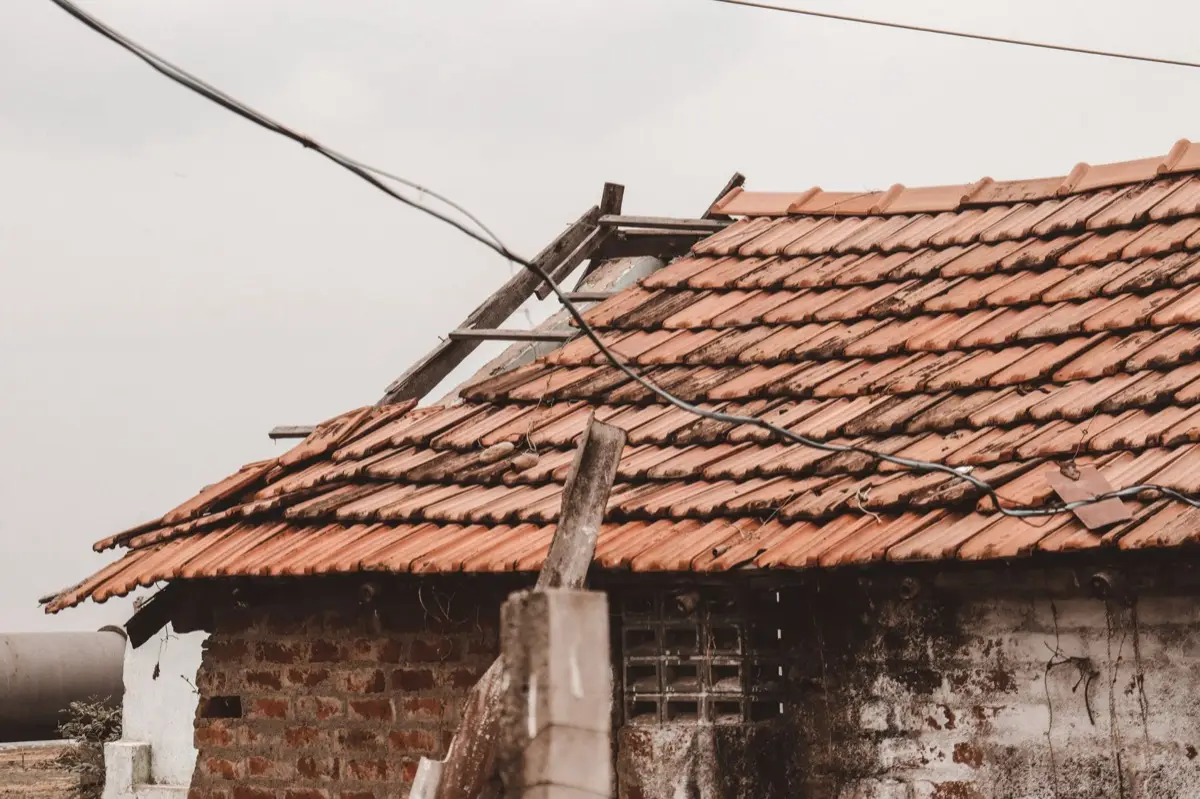
Council Bluffs Roof Pros provides professional wind damage roofing in Council Bluffs, IA for residential and commercial properties across Pottawattamie County and the Iowa bluff line. Everything else on this site leans on the mechanism described here, so it is worth stating plainly. Wind meeting a tall, steep escarpment does not slow and go around it. The flow compresses and accelerates over the crest, and roofs on that crest sit in the fast part of it.
ASCE 7 puts a number on that. When a hill or escarpment is isolated, unobstructed upwind, steep enough that its height over half-length ratio clears roughly a fifth, and tall enough for the site's exposure category, the standard requires a topographic factor greater than one. The Loess Hills clear every one of those tests along the western face above this city, which is precisely why the bluffs look the way they do.
The factor multiplies velocity pressure, so effective wind speed rises with its square root. Put a factor near one and a half on a crest lot and a mapped 115 mph starts behaving like something closer to 140. That is not a rounding difference. It moves a house clean across a line in the code's own shingle classification table, and it explains which streets lose shingles every few years and which never do.
Failures then follow a predictable sequence, and you can read it off a roof from the ground once you know it. The rake starter goes first, because a shingle overhanging an unsealed rake is a lever with wind underneath it. Ridge cap goes next, since cap shingles carry single fasteners and sit exactly where the flow is fastest. Then the field tabs inside the perimeter band, peeling inward course by course from a corner.
Repairs follow that same order backward. Re-nail the perimeter band with ring-shank fasteners. Replace the starter with a properly sealed course. Reset the cap. Hand-seal tabs one at a time wherever cold weather stopped the factory strip from bonding. On a five-year-old roof all of that comes to a fraction of a replacement, and selling a tear-off that could reasonably wait several more years is not something we are interested in doing.
One honest limit, because it matters. None of this applies to a tornado. The night one went through Minden in April 2024, no shingle class and no fastener pattern anywhere in the code book would have changed the outcome for the houses in its path, and anybody telling you otherwise is selling something. Design wind is an ordinary, repeating, survivable load, and it is the one this specification is written for.
Our licensed and insured team brings the right materials and equipment to every job — ASTM D7158 Class G shingles, hand-sealed perimeter courses, six-nail ring-shank fastening, baffled ridge vent with weather filter, ES-1 tested edge securement, eave ice barrier underlayment — and backs the work with a written workmanship warranty. We serve Council Bluffs and nearby communities including Carter Lake, Glenwood, Missouri Valley, Avoca.
What We Handle
Everything our wind damage roofing in Council Bluffs covers
One crew, one point of contact, and the full range of wind damage roofing work in Council Bluffs, IA. If it is on this list we do it in house rather than handing it to a subcontractor:
- wind damage roof repair
- shingle blow off
- roof uplift damage
- topographic wind factor
- ridge cap replacement
- rake starter course
- hand sealing shingles
- wind rated shingles
- roof re-nailing
- wind damage inspection
- escarpment wind exposure
- high wind roof repair
Not sure which one describes your situation? Describe it in plain words and we will sort it out — or browse the rest of our Council Bluffs services.
Materials, equipment and how we do wind damage roofing
The difference between wind damage roofing that lasts and wind damage roofing that gets redone in three years is almost always preparation and materials, not the finish you see on day one. We work with ASTM D7158 Class G shingles, hand-sealed perimeter courses, six-nail ring-shank fastening, baffled ridge vent with weather filter, spec them to the job instead of to the invoice, and write the material grades into the free estimate so you know exactly what you are buying.
Every Council Bluffs job runs the same way: site walk and measurements, written scope and fixed price, protection of the surrounding area, then the work itself with a daily clean-up. Years of roofing work in Pottawattamie County and the Iowa bluff line means we have already met whatever your property is going to throw at us — awkward access, older construction, an HOA with opinions.
Where we do wind damage roofing outside Council Bluffs
Council Bluffs Roof Pros covers Council Bluffs and the surrounding communities of Pottawattamie County and the Iowa bluff line. Crews run out to the same nearby cities every week, so an out-of-town job does not mean an out-of-town price.
- Wind Damage Roofing in Carter Lake, IA — Pottawattamie County, population 3,791
- Wind Damage Roofing in Glenwood, IA — Mills County, population 5,073
- Wind Damage Roofing in Missouri Valley, IA — Harrison County, population 2,678
- Wind Damage Roofing in Avoca, IA — Pottawattamie County, population 1,683
- Wind Damage Roofing in Oakland, IA — Pottawattamie County, population 1,524
- Wind Damage Roofing in Treynor, IA — Pottawattamie County, population 1,032
Start on the Council Bluffs Roof Pros homepage for a free estimate, or call (844) 511-2320 and describe the job.
Why Council Bluffs Chooses Council Bluffs Roof Pros
- ✓Every quote states where your address sits on the bluff line, because the wind specification on the crest is not the specification down in the bottoms.
- ✓We read the wind class off the actual shingle wrapper with you standing there, and explain what that rating assumes about your lot before you sign.
- ✓City Class E roofing license, number lettered on both sides of the truck and printed on the estimate, not merely a state registration number.
- ✓Crest roofs get their tabs hand-sealed in cold weather rather than left to hope the factory adhesive bonds before the next windstorm arrives.
The standards behind wind damage roofing
Quality here is not a matter of opinion — it is written down. The wind damage roofing work we do in Council Bluffs follows published industry standards: NRCA publishes the Roofing Manual, the industry's reference for details and slope minimums, and Asphalt Roofing Manufacturers Association sets the shingle application and ventilation guidance the warranties reference. If a contractor cannot tell you which standard a detail comes from, that is worth asking about before you sign.
Every wind damage roofing project in Council Bluffs gets the same attention, whether it is a single room or a full commercial job. We show up on schedule, keep the site clean, and stand behind the work — the estimate is free and there is no pressure.
Ready to get started? Call (844) 511-2320 for a free wind damage roofing free estimate in Council Bluffs, or request a quote and we'll get right back to you.